












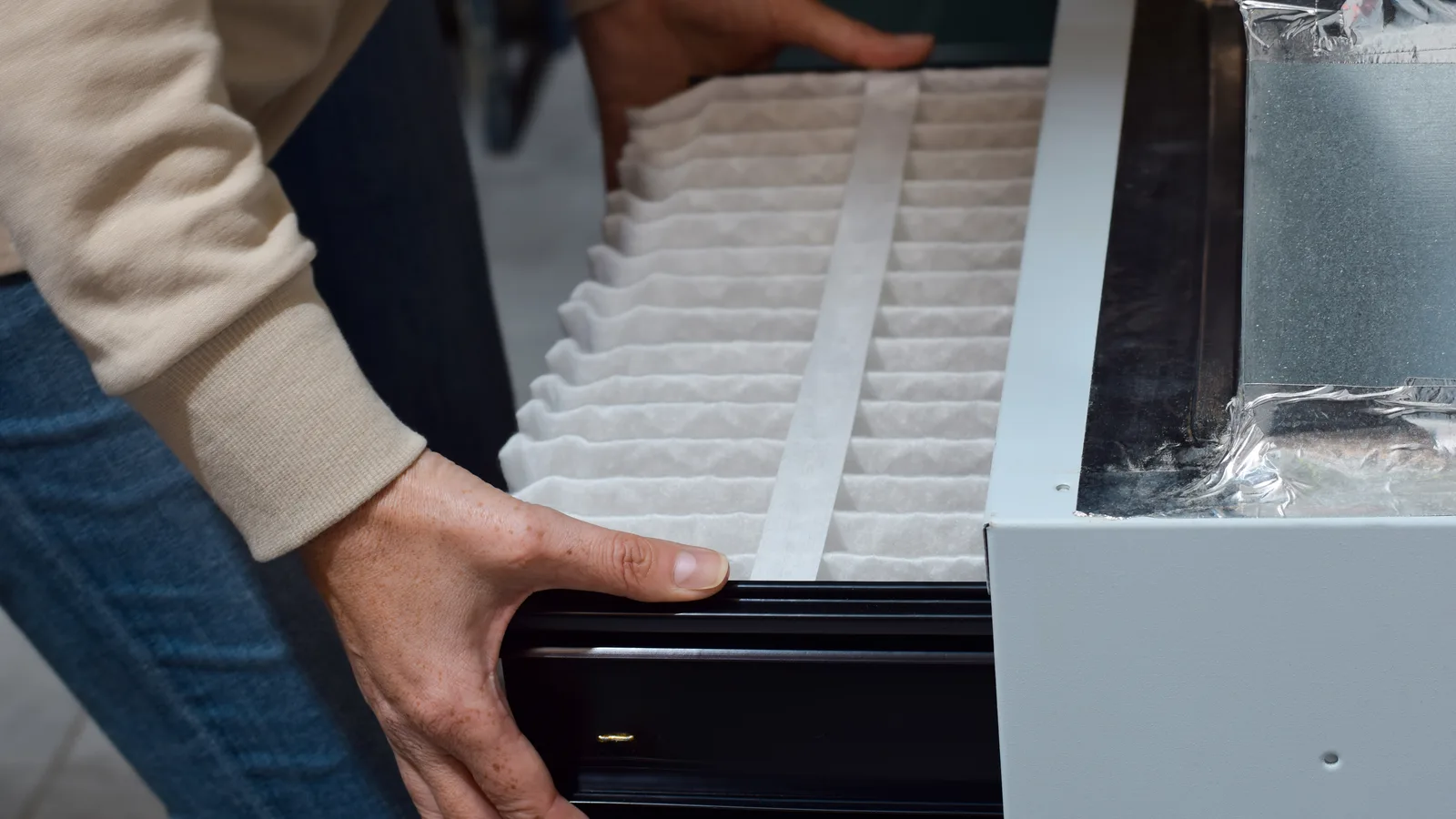
Most furnace filters carry their own instructions: a size printed on the frame and an arrow that shows which way air should move through them. Reading those two marks on the old filter before it comes out is most of the job. The rest is shutting the system off, sliding the new filter in the same way, and knowing what the MERV number on the package does and does not tell you.
Find the Filter Slot
Carrier says the filter usually sits in the blower compartment of the furnace or in the ductwork that feeds air into it. Trane adds two other common spots: a cabinet beside the furnace (in a basement, attic or utility closet) and behind a large return air grille on a wall or ceiling. Some homes have more than one return grille with a filter in each, so it is worth checking every large grille once to learn the layout.
Turn the System Off First
Carrier's steps start by turning the system off, either at the thermostat or at the power switch mounted on or near the furnace cabinet, which often looks like an ordinary light switch. With the blower off, the old filter comes out without loose dust being pulled into the fan, and the access panel can be opened safely. Remove the blower door or the duct access panel only as far as the owner's manual describes.
Read the Old Filter Before You Pull It
- Size: Trane notes that most filters have the size printed on one or more edges of the frame. That label is a nominal size, and the filter's real dimensions can run about half an inch smaller. If no size is printed, measure length, width and thickness, or check the furnace manual.
- Arrow: Look for the airflow arrow, usually on the top edge. Carrier explains that air travels from the ductwork into the furnace, so the arrow on the new filter points toward the furnace and its blower motor, the same way the old one faced.
- Fit: EPA's guide to air cleaners says the filter should fit snugly so air does not leak around its edges, without being bent or crushed to get it in. Residential filters come in thicknesses from 1 to 5 inches, and the slot dictates which one fits.
Slide the new filter in with the arrow pointing toward the furnace, close the panel, and turn the system back on.
What the MERV Number Means
MERV stands for Minimum Efficiency Reporting Value. According to EPA's technical summary on residential air cleaners, it comes from ASHRAE Standard 52.2, the most widely used test method in the United States for filters installed in ducts. The test measures how well a filter removes particles from 0.3 to 10 micrometers across, and results are reported on a scale from MERV 1 to MERV 16. A higher number means higher removal efficiency for most particle sizes.
The finest particles are where ratings separate. EPA says filters rated MERV 13 and above must remove at least 50 percent of the smallest particles tested (0.3 to 1 micrometer). For a household that wants to upgrade, EPA's guidance is to choose at least MERV 13, or the highest rating the system fan and filter slot can accommodate.
When a Higher Rating Restricts Airflow
A denser filter pushes back harder against the air moving through it. EPA's technical summary notes that existing home systems may not have enough fan capacity to handle a filter with a higher pressure drop, and that airflow can fall to the point where heating or cooling capacity is lost. It also notes that a filter loaded past what it can support can let air bypass around its edges. EPA's consumer guide says most systems can take a MERV 13 filter without equipment problems if it is changed often, and that a professional HVAC technician can measure whether a specific system can handle the added resistance. Rooms that heat unevenly or weaker airflow at the registers after switching filters are the question to bring to that technician.
How Often to Check and Change It
ENERGY STAR, the program run by EPA and the Department of Energy, recommends checking the filter every month, especially in winter and summer when the system runs the most. If it looks dirty after a month, replace it, and change it at least every three months either way. A dirty filter slows airflow and makes the system work harder. EPA's guide adds that replacement is typically recommended every 60 to 90 days, and sooner when the old filter comes out heavily soiled. Carrier notes that thin 1 inch filters may need changing about monthly, while 4 inch filters often last around six months. The filter maker's printed interval is the one to follow for a given product.
The Next Step
Pull the current filter this week, write its printed size and MERV rating on the furnace cabinet or in the owner's manual, and mark the airflow direction beside the slot. That turns every future change into a one minute job and gives an HVAC technician the facts needed if a higher rating is on the table.
Electrical, gas, roof and ladder work can cause serious injury. Shut off power or gas first, follow the manufacturer's instructions and local code, and hire a licensed pro for anything beyond your experience.
Loading comments…