












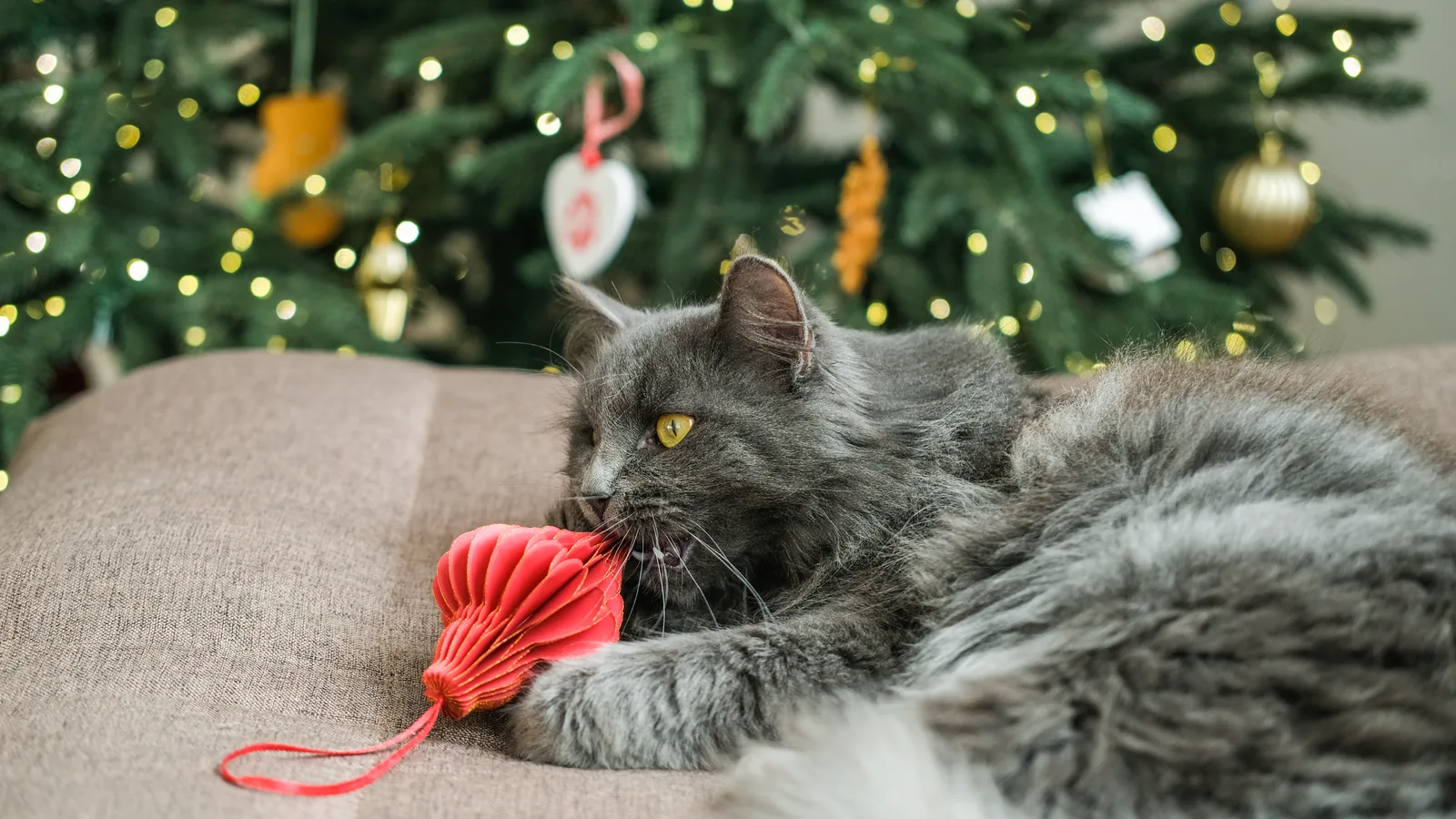
A swallowed strand of ribbon or tinsel can tangle inside a pet's stomach or intestines and, if it is not removed, cut through the gut lining and set off an infection that can kill, according to the U.S. Food and Drug Administration. That single hazard is the reason veterinarians treat the decorated tree as one of the riskiest objects in a home with a cat or dog. The guidance from FDA and from veterinary colleges at Cornell, Purdue, Texas A&M and NC State points to five specific problems: the water in the stand, strands of tinsel and ribbon, light cords, breakable ornaments and the tree itself falling over.
Why string-shaped objects are the most serious
FDA's consumer guidance explains the appeal plainly: to a cat or dog, sparkly, wiggly tinsel and ribbon look like small prey that is easy to catch. Cats are the most frequent offenders, according to the FDA and Purdue's veterinary college.
The danger comes from the shape. A long, thin item does not simply sit in the stomach like a swallowed toy. FDA says ribbon and string can bunch up in the stomach or intestines, and Cornell's Feline Health Center describes what happens when one end catches, often around the base of a cat's tongue: as the gut keeps moving, the strand pulls tight and can perforate the intestines. Cornell calls that outcome life threatening. Some tinsel passes on its own, Cornell notes, while other cases need surgery.
FDA lists the signs to watch for after a pet may have eaten string, ribbon or tinsel:
- vomiting
- diarrhea
- loss of appetite
- lower activity than usual
Those signs can show up within a few hours or take several days, according to FDA. Its advice is to call a veterinarian as soon as you know or suspect a pet ate any of these materials, rather than waiting to see whether symptoms develop.
The prevention steps from both agencies are simple: keep tinsel off the tree entirely, skip long ribbon ties on gifts placed under the tree, and gather up every scrap of ribbon and string once presents are opened.
The water in the stand
A live tree needs a full reservoir, and dogs and cats will drink from it. NC State's veterinary college says tree water can contain preservative chemicals or fertilizer that may cause nausea or diarrhea, and Purdue's veterinary college describes tree water as toxic when fertilizer has been added. Cornell's advice is to use plain water only, with nothing mixed in, and to block pets from reaching the stand. Texas A&M recommends a stand that can be covered.
Light cords and plugged-in wires
Purdue's veterinary college warns that dogs and cats are tempted by the cords of electric decorations, and that chewing them can cause burns, seizures and death. Cornell notes the risk is highest when the cord is plugged in. Its suggestions are to tie cords up out of reach or run them through a heavy plastic cord protector that can be fixed along a wall or baseboard, and to unplug lights when no one is home to watch.
Breakable ornaments
Glass and ceramic ornaments can shatter when batted off a branch, leaving sharp pieces on the floor and in a pet's paws or mouth, according to Cornell. Cornell recommends cloth, straw, wood or other unbreakable ornaments, tied on with cloth loops instead of metal hooks. NC State suggests reserving the lower branches, the ones a pet can reach, for unbreakable pieces. FDA adds one ornament that is a poisoning risk rather than an injury risk: homemade salt dough, which carries enough salt to sicken or kill a small pet. FDA treats eating salt dough as an emergency that calls for an immediate veterinary visit.
A tree that can fall
Cats climb trees, and dogs bump into them. Cornell, Texas A&M and NC State all recommend anchoring the tree so a pet cannot pull it down. Cornell describes tying the top to the ceiling with a cup hook and wire or string, and Texas A&M suggests securing it to a wall or ceiling. A fallen tree can injure a pet directly and scatter broken ornaments, spilled water and live wires across the floor at once.
What to do before the tree goes up
The step that covers most of these risks is deciding where the tree goes and how it is secured before any decorations go on: anchor it, choose a covered stand filled with plain water, route and protect the cords, hang only unbreakable ornaments on the bottom third and leave tinsel in the box. Then save two numbers in your phone: your regular veterinarian and the closest 24-hour emergency animal hospital, so a swallowed ribbon or a chewed cord gets a call the same day.
Sources
- U.S. Food and Drug Administration: Keep Your Dogs and Cats Safe From Holiday Hazards
- U.S. Food and Drug Administration, Center for Veterinary Medicine: Take the Oh No! Out of Your and Your Pets' Holiday Ho-Ho-Ho!
- Cornell University College of Veterinary Medicine, Cornell Feline Health Center: Beware Holiday Hazards
- Purdue University College of Veterinary Medicine: Tips to Have a Pawsitively Pet Safe Holiday
- Texas A&M College of Veterinary Medicine & Biomedical Sciences: Deck the Paws, Ensuring a Pet-Safe Holiday Home
- NC State College of Veterinary Medicine: Holidays and Pets, How to Keep Them Safe this Season
Loading comments…