












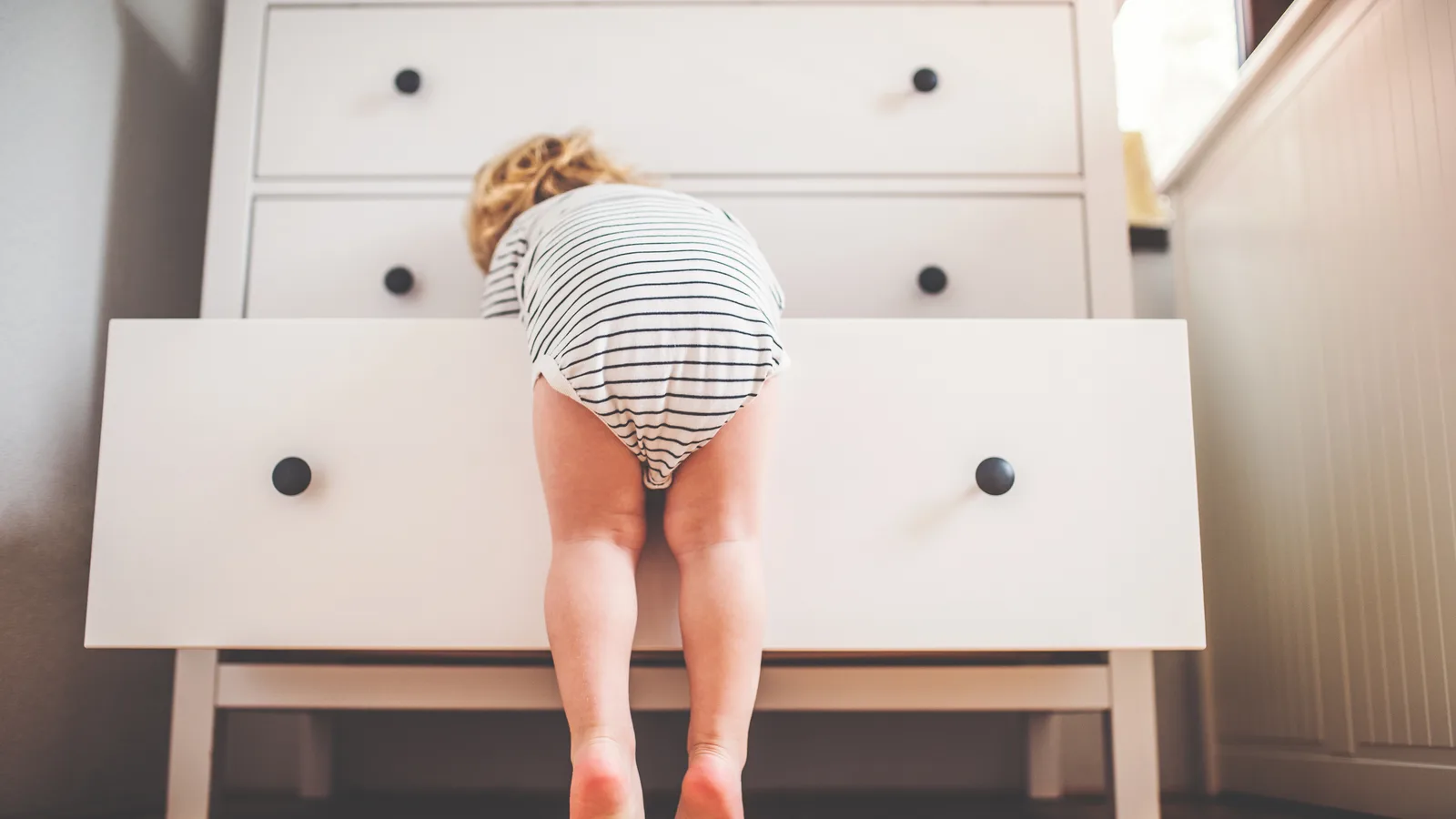
Any dresser, chest or armoire made after September 1, 2023, and sold in the United States has to stay upright while a 60-pound weight hangs from an open drawer, with its back legs propped up as if it were standing on carpet. That requirement comes from a federal stability standard for clothing storage units, codified at 16 CFR part 1261. It does not cover the dresser already in your bedroom, the bookcase in the den or the television on top of either, which is why the U.S. Consumer Product Safety Commission (CPSC) still tells households to anchor all of them to the wall.
Where the rule came from
Congress passed the STURDY Act (Stop Tip-overs of Unstable, Risky Dressers on Youth) in December 2022. It told the CPSC to check whether the industry's voluntary standard tested for three things: stability on carpet, stability with loaded drawers and several drawers open, and the weight of children up to 60 pounds pulling or climbing on the unit. CPSC found that the voluntary standard ASTM F2057-23 met those terms, voted 3 to 1 in April 2023 to make it mandatory, and published the rule in the Federal Register in May 2023. CPSC says the standard is meant to protect children up to 72 months old.
What a covered unit has to survive
The rule reaches any free-standing unit at least 27 inches tall, weighing at least 30 pounds, with at least 3.2 cubic feet of enclosed storage. CPSC's business guidance says that includes fabric dressers with drawers if they meet those measurements. A unit must pass all three of these tests:
- Clothing load. Every door and drawer that is not blocked by an interlock is opened. Where more than half the storage volume is pulled out, the drawers are filled at 8.5 pounds per cubic foot to stand in for folded clothes, and the unit must hold for 30 seconds.
- Pushing force. A 10-pound horizontal force is applied at the highest hand hold, up to 56 inches off the floor, for 10 seconds.
- Carpet and a child's weight. A test block goes under the rear legs to tilt the unit forward the way a thick rug does, and a 60-pound weight hangs from the front of whichever drawer or door is most likely to tip it, for 30 seconds.
Each unit must also ship with an anti-tip device that meets a separate standard, ASTM F3096, and must pass the stability tests without that device installed.
What the latest tip-over numbers show
CPSC's most recent annual tip-over report, published in February 2024, estimates that televisions, furniture and appliances falling over sent an average of 17,800 people a year to emergency rooms from 2020 through 2022. Furniture was involved in 82 percent of those injuries, a television alone in 15 percent and an appliance alone in 3 percent. Children under 18 accounted for 44 percent of the injuries while making up 22 percent of the population, and people 60 and older accounted for 24 percent.
The same report counts 217 deaths reported to CPSC from January 2013 through July 2023. Of those, 155 (71 percent) were children and 56 were people 60 or older. A television was part of 103 of the deaths, either falling alone or coming down with the furniture it sat on. Chests, bureaus and dressers were involved in 79 deaths, and 27 of those also involved a falling television. In 56 of the 72 furniture-related child deaths where the circumstances were known, a child had been climbing on the furniture or the TV. CPSC notes that counts for 2021 through 2023 are likely incomplete because of reporting lag, and that these figures are not comparable with its earlier reports because the counting method changed.
The report ties a long decline in television injuries to the market shift from heavy tube sets to flat screens, though 54 of the deaths involved a television and the furniture under it falling together.
How CPSC says to anchor furniture and TVs
CPSC's Anchor It campaign recommends securing every piece of furniture with drawers, doors or shelves, along with televisions, regardless of when it was made or bought. Its installation guidance for a strap and bracket kit covers these points:
- Find a wall stud with a stud finder (studs usually sit 16 or 24 inches apart) and drive the wall bracket's screws into it. Steady resistance while drilling tells you that you are in the stud.
- On brick or concrete, drill into the brick face rather than the mortar with a masonry bit and use self-anchoring masonry screws. CPSC suggests a contractor or building superintendent for brick.
- Fasten the furniture bracket into a thick, solid part of the piece, never the thin stapled back panel or a veneered edge.
- For a flat-screen TV, use the standard mounting holes on the back with the hardware in the kit.
- Pull on both ends of the strap afterward. There should be no slack and nothing should shift.
If a TV cannot be anchored, CPSC says to set it on a low, sturdy base pushed as far back as possible, keep cords out of reach, and keep remotes and toys off furniture where a child would climb to get them. Heavier items belong on lower shelves.
The practical next step
Before a new television goes up or onto a stand this season, check what will hold it. Look for the anti-tip kit that came in the box of any dresser made since September 2023, and buy a strap kit for older dressers, bookcases and the TV itself. CPSC also recalled millions of New Age Furniture anti-tip kits whose plastic zip ties may turn brittle; if a dresser made in November 2019 or later came with one, CPSC directs owners to Alliance4Safety for a free replacement. Report a tip-over or an unstable product at SaferProducts.gov or to the CPSC hotline at 800-638-2772.
Sources
- U.S. Consumer Product Safety Commission: Clothing Storage Units (16 CFR part 1261) business guidance
- U.S. Consumer Product Safety Commission: CPSC Adopts Final Consumer Product Safety Standard to Prevent Tip-overs of Dressers and Other Clothing Storage Units
- U.S. Consumer Product Safety Commission: Product Instability or Tip-Over Injuries and Fatalities Associated with Televisions, Furniture, and Appliances: 2023 Report
- U.S. Consumer Product Safety Commission: CPSC Reminds Families to Tackle the Deadly Hazard of TV and Furniture Tip-Overs (February 2024)
- U.S. Consumer Product Safety Commission, Anchor It: How to Install a Kit
- U.S. Consumer Product Safety Commission: Anchor It
Loading comments…