












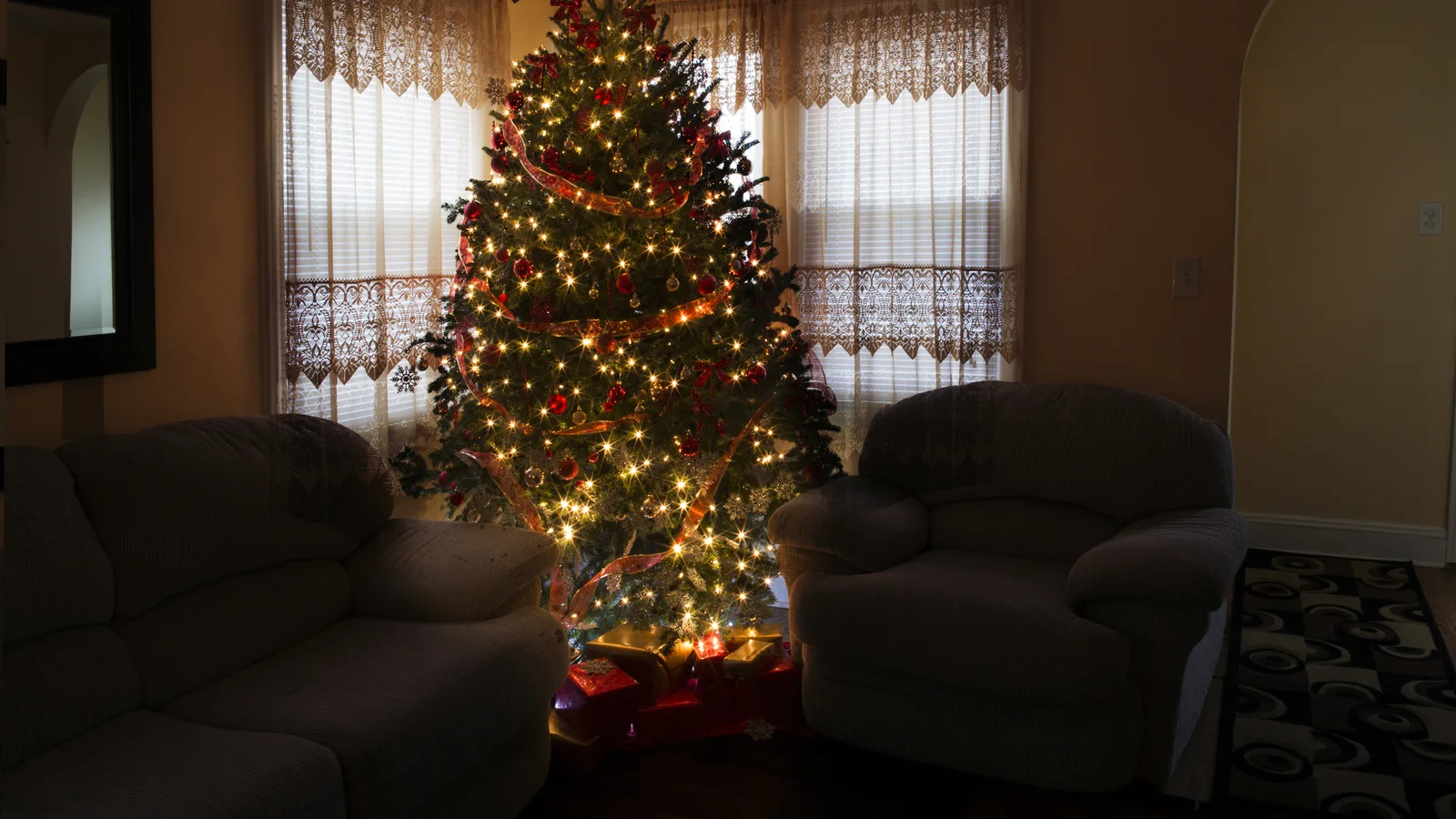
When a Christmas tree is cut, more than half of its weight is water, according to the care guidance the National Christmas Tree Association (NCTA) publishes for farm-grown trees. Most of what keeps a tree green through December, and most of what keeps it from becoming a fire hazard, comes down to holding on to that water. The association's guidance, prepared by Dr. Gary Chastagner and Dr. Eric Hinesley, covers the setup step by step, and the National Fire Protection Association (NFPA) supplies the numbers on what happens when a tree dries out.
Step 1: a fresh, straight cut
Before the tree goes in the stand, the NCTA says to saw a disk about half an inch thick off the base of the trunk. The cut should be straight across, perpendicular to the trunk. Cutting at an angle or into a V makes the tree harder to hold upright and reduces the amount of water available to it, and drilling a hole in the base does not improve water uptake, the guidance says.
Timing matters. Most species can go six to eight hours after the trunk is cut and still take up water, so the tree should go into water as soon as possible once it is home. A tree that will not be set up right away can be stored for several days in a cool place with the freshly cut trunk in a bucket that is kept full.
Step 2: a stand sized to the trunk
The association's rule of thumb is that a stand should hold 1 quart of water for every inch of the trunk's diameter. A tree with a 4-inch trunk, by that measure, needs a stand that holds a gallon.
The stand should fit the tree as it is. The guidance says not to whittle down the sides of the trunk to squeeze it into a small stand, because the outer layers of wood are the most efficient at taking up water.
Step 3: check the water every day
The level should never drop below the base of the trunk. The NCTA points out a trap in many stands: there can still be water in the reservoir after the base of the tree is no longer sitting in it. The check is whether the cut end is under water, not whether the stand looks wet. The temperature of the water does not matter and does not affect uptake, the guidance says.
Step 4: place it away from heat
The association says to keep trees away from major sources of heat, naming fireplaces, heaters, heat vents and direct sunlight. A cooler room slows drying, so the tree uses less water each day.
The fire data supports the placement advice. On its winter holidays page, NFPA says a heat source too close to the tree causes nearly one in four home Christmas tree fires, and almost half of those fires, 48 percent, start in the living room.
Step 5: lights that run cool, switched off at night
Lights that produce little heat, such as miniature lights, reduce drying, the NCTA says. Its guidance is to inspect every light set before it goes on the tree, replace any set that is worn, avoid overloading electrical circuits, and turn the tree lights off when leaving the house or going to bed.
According to NFPA, electrical distribution or lighting equipment was involved in two in five home Christmas tree fires, or 40 percent. Lamps or bulbs started nearly one in four, 24 percent, and candles started 11 percent.
What the fire numbers show
Christmas tree fires are uncommon. From 2020 through 2024, fire departments in the United States responded to an average of 143 home fires a year that started with a Christmas tree, NFPA says, and it puts the toll of those fires over that period at an estimated 7 civilian deaths, 13 civilian injuries and $15 million in property damage. By comparison, the association counts an estimated average of 835 home fires a year that begin with other decorations.
What sets tree fires apart is speed. NFPA's page describes a live burn in which a dried-out tree reached flashover, the point at which a room's contents ignite together, in less than one minute, while a well-watered tree burned at a much slower rate.
Step 6: take it down on time
Trees become more flammable as they dry, and 35 percent of Christmas tree fires happen in January, NFPA says. The NCTA's guidance is to monitor the tree for freshness and to remove it from the house after Christmas or whenever it becomes very dry. It adds one prohibition: never burn any part of a Christmas tree in a wood stove or fireplace.
The association's site has a tree recycling page for finding a local program. The step worth taking before the tree is bought is to measure two things at home: the ceiling height where it will stand, and the water capacity of the stand, which decides how thick a trunk it can keep supplied.
Loading comments…