












A bag of tulip bulbs bought in September and still sitting in the garage in the third week of November is a common find. Whether it is too late to plant them depends on the bulb and on the ground. University of Minnesota Extension, writing for a cold-climate state, says the usual planting window for hardy bulbs there runs from mid-September to mid-October, so that the bulbs can grow roots before the ground freezes. It then makes one exception by name: tulips can be planted as late as a gardener can get them into the soil.
That guidance is written for Minnesota, and the guide's own plant list is for U.S. Department of Agriculture hardiness zones 3 and 4. The window is tied to when the ground freezes, which differs by region. The steps below follow the extension service's planting guide; each state's own extension service publishes the dates for its climate.
Why spring bulbs go in during fall
Tulips, daffodils, crocuses and hyacinths are hardy bulbs. They need a period of cold to break dormancy and begin developing spring flowers, the extension service says, which is why they are planted in fall and left in the ground. Illinois Extension describes a bulb as an underground storage structure holding the plant's nutrient reserves, and notes that spring bulbs begin growing again in fall, well before anything shows above ground.
Step 1: check the bulbs
A sound bulb is firm and has its papery skin, the Minnesota guide says. Bulbs that are soft or moldy should not be planted, and cuts and bruises are signs of damage. Bulbs waiting to be planted belong in a dry place out of direct sunlight.
Step 2: pick the spot
Bulbs grow best in rich, well-drained soil, and the guide says to avoid any area where water stands. Wet soil from poor drainage or heavy clay is one of the causes of bulb rot it lists. Light matters after the flowers fade, because the leaves store energy in the bulb for the following year, but hardy bulbs can go under deciduous trees and shrubs: they finish blooming before the canopy fills in.
The guide flags one location. Soil beside a foundation with a southern or western exposure warms early, which can bring bulbs up ahead of the season and expose them to cold damage. Mulch there slows the warming.
Step 3: prepare the soil
Clear rocks, sticks and matted roots, then work organic matter such as fine compost, peat moss or shredded leaves into the planting area with a garden fork or tiller. On fertilizer, the guide is specific to its state: most Minnesota soils are rich in phosphorus, so unless a soil test shows a shortage of phosphorus or potassium, it says to skip the fertilizer and add compost. Fertilizers very high in nitrogen and fresh manure are both on its list of causes of rot. A soil test through a state extension lab answers the question for any other yard.
Step 4: set the depth by the bulb
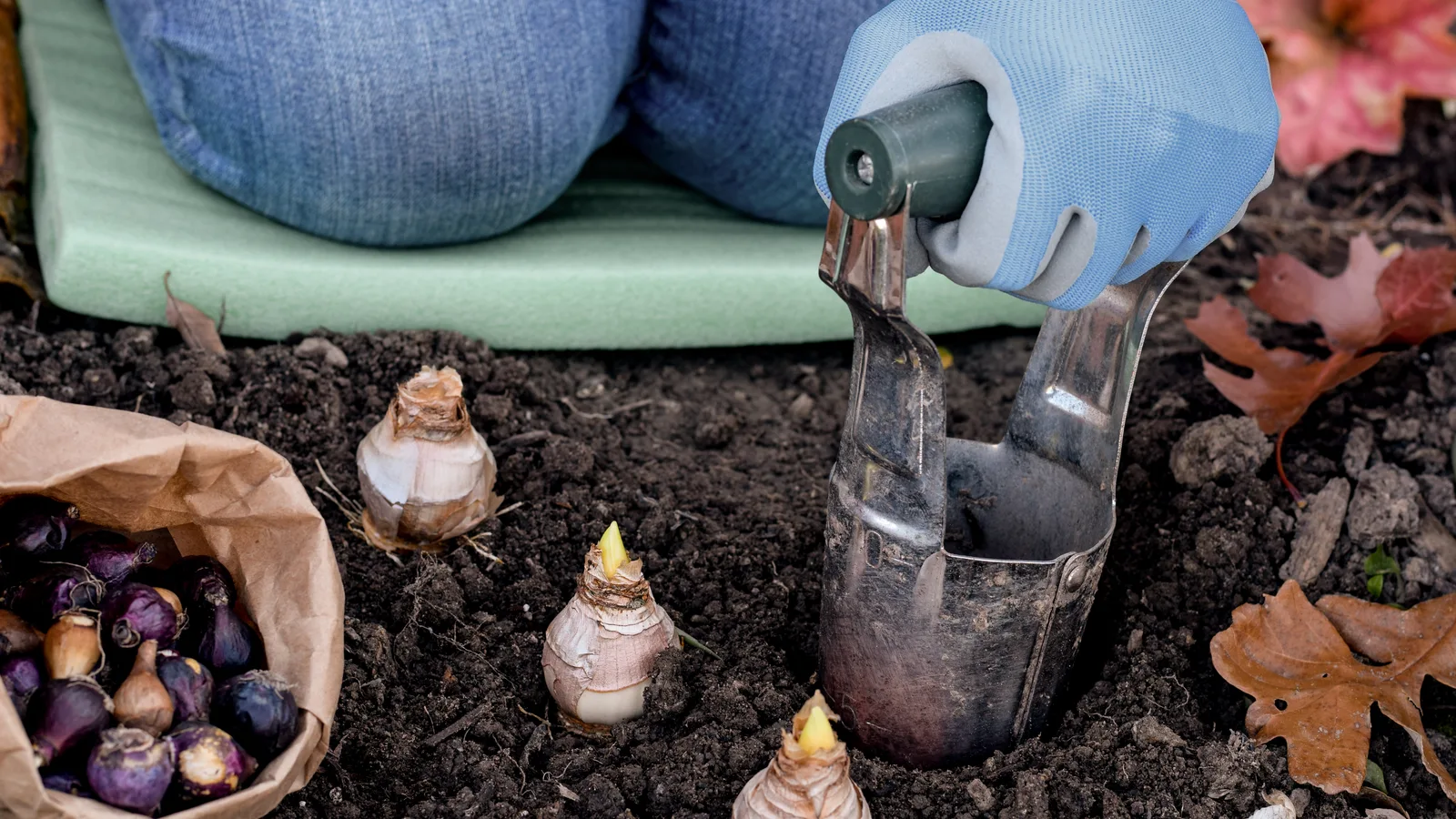
The package directions come first. Where there are none, the guide's general rule is to plant a bulb two to three times deeper than its diameter. A bulb 2 inches across goes 4 to 6 inches down by that rule. Soil type adjusts it: 1 or 2 inches deeper in light, sandy soil, and an inch or two shallower in heavy clay.
Set each bulb with the pointed end up and its base resting at the planting depth. The guide notes that bulbs look better planted in odd-numbered groups or in masses than in single file.
Step 5: backfill in two stages, with water between
Once the bulbs are placed, cover them with half the soil and soak the area thoroughly. Then add the rest of the soil and rake the bed level. If the rest of fall is dry, the guide says to water until the soil is wet all the way through.
Step 6: mulch
Water again, then cover the bed with 2 to 3 inches of leaf mulch, wood mulch or clean, seedless straw. The mulch holds moisture and makes the soil temperature fall and rise more gradually as the seasons turn, which is the protection a late-planted bulb most needs.
Step 7: keep the squirrels out
Squirrels and chipmunks dig up and eat newly planted bulbs, tulips especially. Narcissus bulbs, the group that includes daffodils, are poisonous, the guide notes. Its method for the rest: lay chicken wire flat over the planted area, pin it with the U-shaped staples sold for landscape fabric, and cover it with mulch. The shoots grow through the openings in spring. A label marking what went where prevents an accidental dig-up later.
What late planting can cost
The guide lists planting too late in the season, along with planting too shallow, among the reasons bulbs flower poorly in their first year. Tulips are the exception it names; it does not extend the same allowance to other hardy bulbs. For a gardener holding tulips in late November, the guide's test is the soil: if it can still be dug, they can still go in.
The next step is local: a state extension service's website gives planting guidance for its own climate, and many run soil testing labs.
Loading comments…