












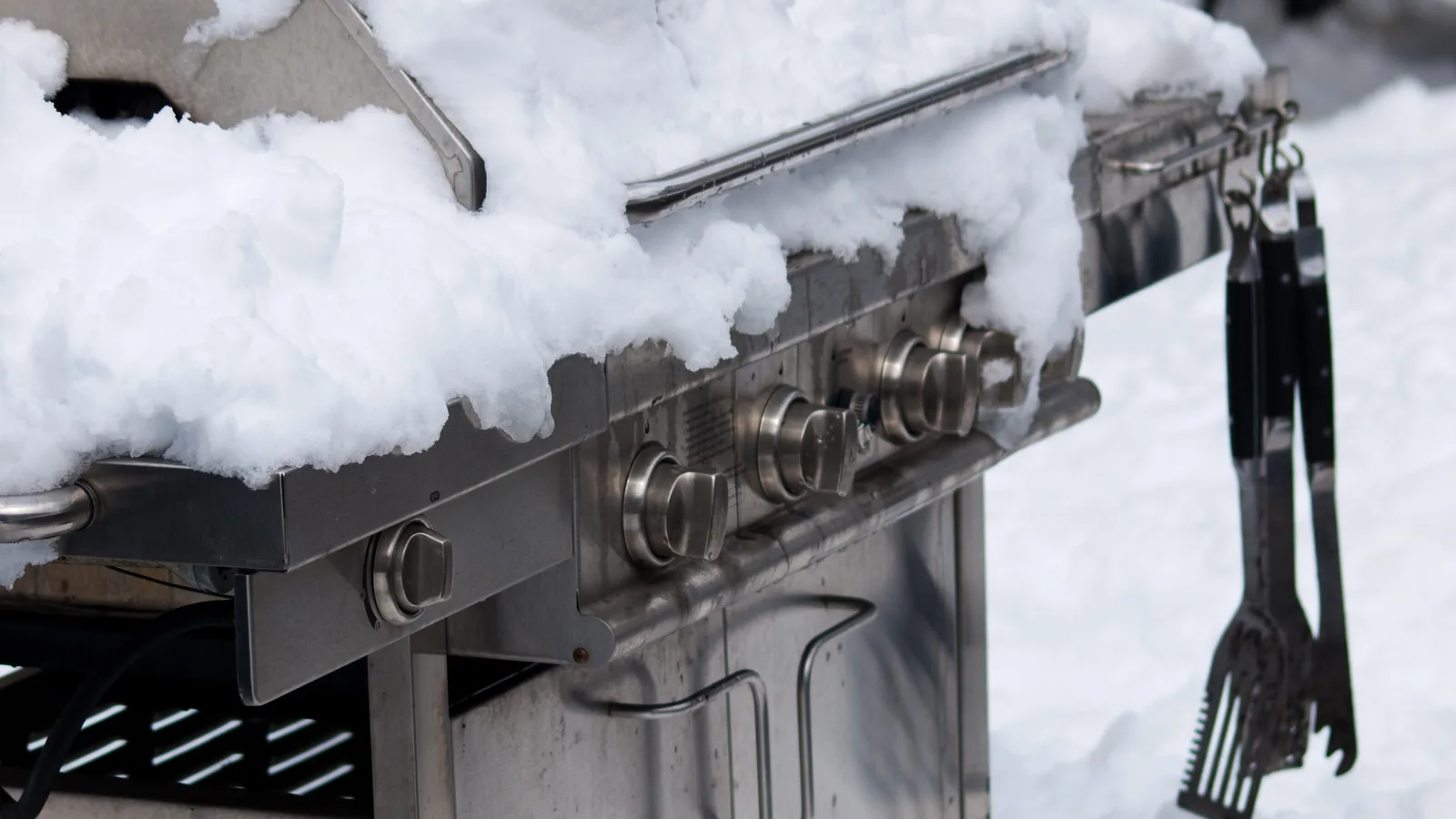
A propane grill can spend the winter in a garage or shed, but its cylinder cannot: Weber's LP gas owner's manual says propane tanks must be stored outdoors, out of children's reach, and never in a building, garage or other enclosed space, and it allows the grill itself indoors only after the tank has been disconnected and removed. The U.S. Consumer Product Safety Commission's gas grill fact sheet agrees: never use or store an LP gas container indoors.
Where the cylinder goes
Upright is the other constant. The CPSC fact sheet says to always keep containers upright, and Weber's manual says the tank must be stored in an upright, secure position and not dropped or handled roughly. The North Carolina Department of Agriculture's LP-Gas section, whose storage rules reference NFPA 58, the national LP-Gas Code, lists the approved position as standing on the foot ring, never on its side or upside down. That page also says propane cylinders, including any that ever held propane, belong outdoors and not in a crawl space or under the house, away from flames and other ignition sources, out of direct sun, and in a spot where the tank cannot be knocked or pulled over.
CPSC and Weber both say a spare cylinder should never be stored under or near the grill. Weber warns against storing or transporting a tank anywhere temperatures can reach 125°F, and notes that a tank that seems empty may still hold gas.
Disconnecting and capping the valve
CPSC lays out the order: turn off the grill's burners and the container valve, disconnect the container by turning the connector clockwise, then put the valve plug back into the valve outlet. Weber's manual adds that a dust cap belongs on the cylinder valve outlet any time the cylinder is not in use, and that only the type of cap supplied with that valve should be used, since other caps or plugs can let propane leak. The North Carolina page draws a further line: plugs are meant for older POL-style valves, and plugging an Acme valve defeats one of its safety features.
North Carolina's guidance treats light surface rust as acceptable after sanding and painting, but says a cylinder with deep pitting, or with severe corrosion at the collar or foot ring, should be seriously considered for replacement.
Testing for leaks with soapy water
CPSC says to check for leaks whenever the grill is reconnected to its container or gas is smelled. Its method: mix one part water with one part liquid detergent, open the supply valve fully, and brush the solution on the connection points. Foam that keeps forming means a leak. If tightening the connection does not stop it, close the container valve and take the grill to an LP gas dealer or qualified appliance repair person, and do not light the grill until the leak is repaired. Weber's manual uses a weaker mix, 20 percent liquid soap to 80 percent water, and says that if the leak is at the cylinder itself, the owner should turn off the gas, not operate the grill, and return the tank to the retailer.
Weber also warns that after a period of storage or nonuse, the grill should be checked for gas leaks and burner obstructions before it is used. CPSC asks owners to check the venturi tubes at least once a year for blockage by insects, spiders or food drippings, and to inspect hoses for cracks, holes and sharp bends.
Covering and cleaning the grill
Weber's storage guidance says a grill does not have to come indoors for winter. Before storage, it suggests brushing the grates and burners, scraping the interior into the grease tray and emptying the drip pan, because leftover grease and food attract wildlife and hold moisture that encourages corrosion. For a grill that stays outside, Weber says a cover helps keep the exterior clean. If mice or other animals nest in it anyway, Weber says to clear out the nesting material and run the grill on high for at least 15 minutes before cooking.
The valve handle and the date on the collar
The overfill prevention device, or OPD, stops a cylinder from being filled past a safe level. CPSC reported in 2001 that a standard published by the National Fire Protection Association requires it on new tanks, and that OPD tanks can be recognized by a three-lobed valve handle, where older tanks have five prongs. The North Carolina page states that cylinders without an OPD cannot be filled after April 1, 2002. Weber's manual requires a listed OPD on any tank used with its grills.
Cylinders also carry a date. Under the federal hazardous materials rules at 49 CFR 180.209(e), a DOT 4B, 4BA, 4BW or 4E cylinder with a corrosion-resistant coating, used only for a non-corrosive gas such as propane, may be requalified by volumetric expansion testing every 12 years. As an alternative, a proof pressure test may be used, repeated every 10 years after the first 12-year period. Weber's own manual sets a tighter requirement for its grills, asking that the tank carry a DOT certification and a testing date within five years of current use.
Refill or exchange
CPSC says a container should be refilled only by an LP gas dealer or a qualified service station operator, never by the owner, and suggests a cylinder exchange as an option. Weber's manual says never to fill a tank beyond 80 percent full.
Before putting the grill away this season, find the cylinder's manufacture or requalification date and the shape of its valve handle; if either looks out of date, ask the propane dealer or exchange retailer whether the tank can still be filled.
Electrical, gas, roof and ladder work can cause serious injury. Shut off power or gas first, follow the manufacturer's instructions and local code, and hire a licensed pro for anything beyond your experience.
This article reports rules, data and expert guidance. It is not legal, tax, insurance or financial advice. Talk to a licensed pro, your tax advisor or your insurer before you act on it.
Sources
- U.S. Consumer Product Safety Commission: Gas Grill Fact Sheet (Publication 467)
- U.S. Consumer Product Safety Commission: CPSC Helps Make Grills Safer
- Weber: LP Owner's Manual
- Weber: Preparing Your Grill for Storage
- North Carolina Department of Agriculture and Consumer Services: Proper Storage of Propane Containers
- North Carolina Department of Agriculture and Consumer Services: What Is That Valve on My Propane Tank?
- Legal Information Institute: 49 CFR 180.209, Requirements for Requalification of Specification Cylinders
Loading comments…