












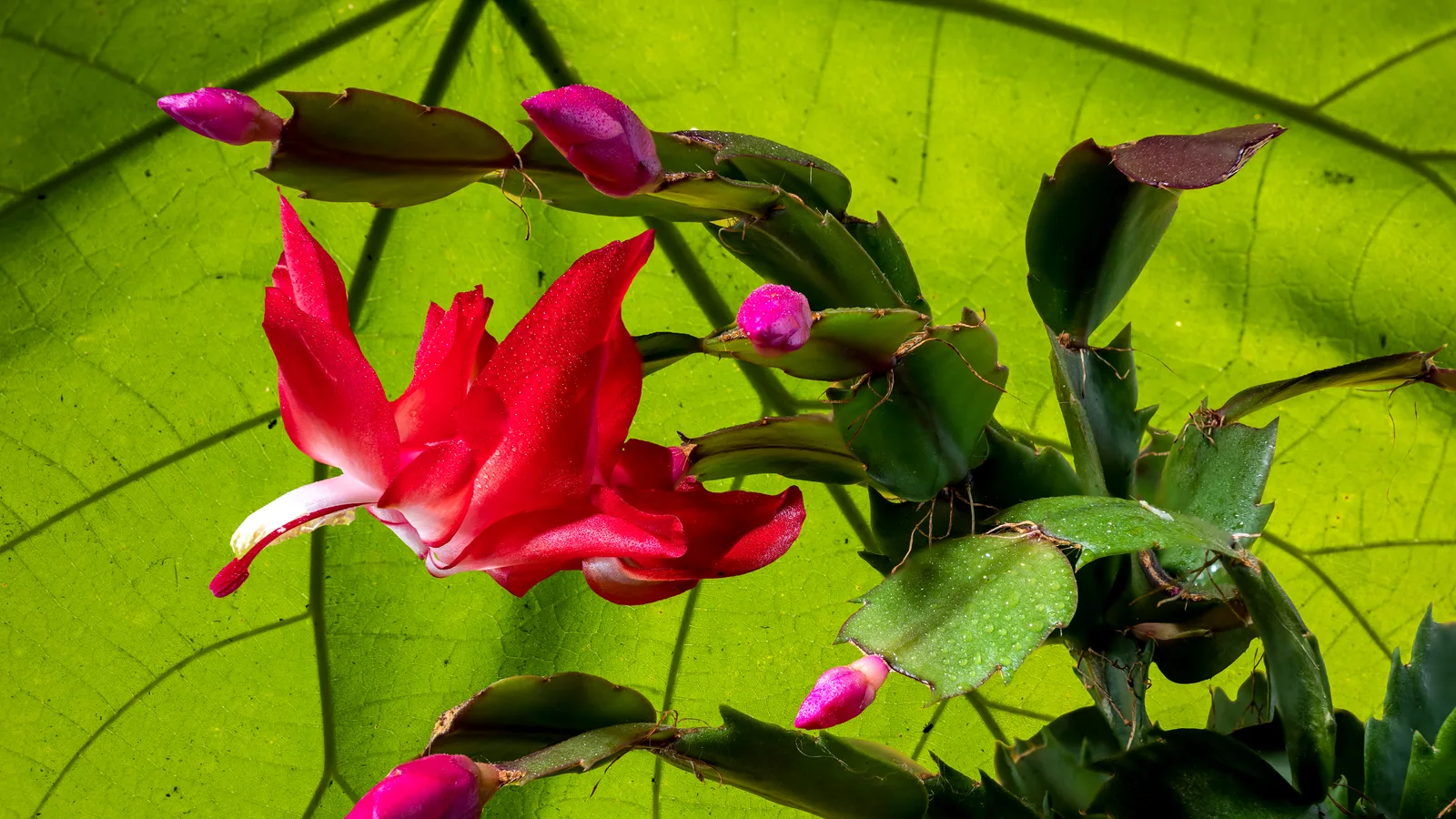
The quickest way to tell a Thanksgiving cactus from a Christmas cactus is to look at the edge of a single flat stem segment. On a Thanksgiving cactus (Schlumbergera truncata), each segment carries two to four pointed teeth along its margins, according to Clemson Cooperative Extension, Iowa State University Extension and Penn State Extension. On a Christmas cactus (Schlumbergera x buckleyi), the margins are rounded and scalloped, with no points. Many plants sold in stores as Christmas cactus are in fact Thanksgiving cactus or hybrids of the two, Iowa State notes, which is why so many of them flower in November.
Three plants, three shapes
The extension publications add a few more clues that help when the stems alone are hard to read:
- Thanksgiving cactus: toothed segments, yellow anthers (Clemson and Penn State), and flowers that grow out more or less horizontally from the stem tips (Penn State). Iowa State gives its bloom window as mid-November to late December.
- Christmas cactus: scalloped segments, purplish-brown anthers, and drooping flowers (Penn State). Iowa State describes it as a hybrid with arching branches that flowers from late November into early February. Under natural day length, Clemson says, the Thanksgiving type blooms about a month ahead of it.
- Easter cactus: a separate plant that Clemson and Penn State list as Hatiora gaertneri (Iowa State uses the name Schlumbergera gaertneri). Its segments are smoother, with small brownish bristles at the tips, and its flowers open flat like a star. It blooms from March to May, according to Iowa State.
None of these plants has true leaves. The green, flattened segments do the work of photosynthesis, Clemson explains.
What makes the buds form
Thanksgiving and Christmas cacti are short-day plants: long, unbroken nights and cool temperatures tell them to set buds. The extension services agree on that principle but do not give identical numbers.
- Night length: Clemson calls for 14 or more hours of continuous darkness a day, starting around mid-September and lasting at least six weeks, and warns that as little as two hours of light during the dark period (a lamp, a streetlight, car headlights) can stop bud set. Iowa State says most plants need 14 to 16 hours, while some cultivars will bloom with 12. Penn State's minimum is 12 hours of uninterrupted darkness.
- Cool nights: Clemson says night temperatures of 50 to 59 degrees Fahrenheit will set buds regardless of day length. Iowa State says some plants bloom at 55 degrees in fall whatever the day length, and that temperatures above 70 degrees prevent flowering. University of Wisconsin-Madison Extension puts the inducing range at 55 to 60 degrees at night.
- If the room stays warm: Wisconsin's guidance for plants kept above 60 degrees is to limit them to about 10 hours of light a day for roughly four weeks, using a dark closet or black plastic, until buds appear.
Once buds are set, Clemson says, they are usually visible within three to four weeks and day length no longer matters. The Easter cactus runs on a different schedule: Iowa State describes three to four weeks of long nights at 60 to 70 degrees, followed by four to six weeks at 47 to 55 degrees, before it blooms in spring.
Why the buds fall off
Bud drop is the most common complaint about holiday cacti, and the extension publications trace it to a handful of causes:
- a sudden change in temperature or light, including moving the plant once buds have formed (Clemson, Iowa State, Wisconsin)
- potting mix that dries out while buds are developing (Clemson, Iowa State)
- overwatering and root loss, since soggy mix invites root rot (Iowa State, Penn State, Wisconsin)
- drafts and cold exposure, such as a chilly trip home from the store (Iowa State)
- temperature extremes: Clemson notes bud drop can occur near 50 degrees and advises keeping plants below 90 degrees after buds set, and that continuously warm conditions also cause buds to fall
- too many buds on one plant (Clemson) and too little light (Penn State)
The practical upshot from Iowa State and Wisconsin is to pick the plant's spot before buds appear and leave it there until the first flowers open.
Water and light while it blooms
Clemson and Iowa State both say to keep the potting mix evenly moist from bud set through flowering, without letting water stand in the saucer. Penn State describes watering thoroughly from the top and watering again once the mix dries. For light, the sources point to bright, indirect or filtered light: Penn State says full sun damages these plants, and Wisconsin advises against long stretches of strong direct sun. At about 70 degrees, Wisconsin says the flowers last two to three weeks; Clemson reports bloom lasting seven to eight weeks at 68 degrees. Iowa State and Penn State put the ideal bloom-time nights at 60 to 65 degrees and 60 degrees respectively.
After the last flower drops
Iowa State and Penn State both recommend watering less often after bloom, and Iowa State suggests a cooler spot. Penn State says spent flowers can be picked off or left to fall. Repotting waits for spring: Penn State says to repot every three to four years, never while the plant is in flower, and Clemson suggests about every three years, noting that the plants flower best when somewhat pot bound. Clemson recommends feeding monthly at half strength from late winter or early spring through summer, then stopping in late summer so the plant puts its energy into fall buds. Wisconsin adds that cutting back on water in August and September helps harden the stems that will carry next year's flowers.
For this week: check the segment edges to know which plant you have, then keep it in one spot with steady, moist soil and no lamp shining on it after dark.
Sources
- Clemson Cooperative Extension, Home and Garden Information Center: Thanksgiving and Christmas Cacti (HGIC 1554)
- Iowa State University Extension and Outreach, Yard and Garden: All About Holiday Cacti
- Penn State Extension: Holiday Cacti Care
- University of Wisconsin-Madison Extension, Wisconsin Horticulture: Holiday Cactus
Loading comments…