












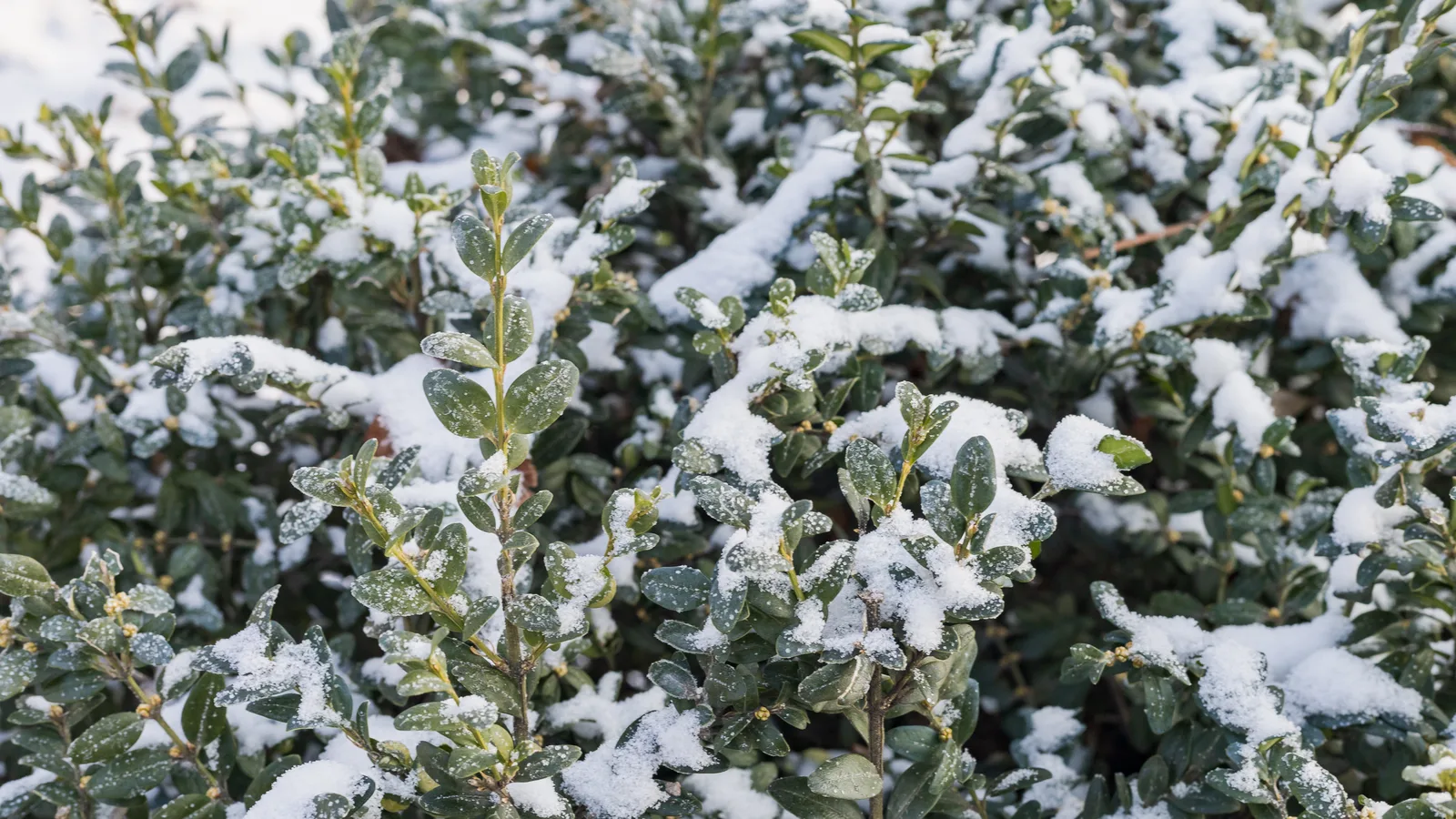
Evergreens keep giving off water through their needles and leaves all winter, and once the soil freezes their roots cannot replace it. Cooperative extension services call the result winter burn or winter desiccation, and their guidance agrees on the main defense: moist soil going into freeze-up, put there by thorough watering in October and November rather than one soaking at the last minute.
Why an evergreen dries out in January
Deciduous trees drop their leaves and shut down water loss for the season. Evergreens do not, Penn State Extension explains, so sun, wind and swings in temperature keep pulling moisture from their foliage while frozen ground holds roots in place. University of Minnesota Extension adds a second mechanism: bright, cold days destroy chlorophyll, which does not re-form below 28°F, leaving foliage bleached. Iowa State University Extension notes that water also leaves through buds and stems, and that wind and sun drive most of the loss.
The damage tends to show on the sides of the plant that take the most sun and wind, which Minnesota identifies as south, southwest and windward faces. Reflected heat from walls, fences and buildings raises the risk, according to Colorado State University Extension. Plants set out in the last two or three years have shallow roots and are the most exposed, Iowa State says.
How much water, and when
Minnesota's schedule is specific about timing: cut back watering slightly in September so plants harden off, then water thoroughly in October until the ground freezes. The same guidance states that watering only in late fall does not reduce injury, because the soil needs to be moist through the root zone before freeze-up, not just at the surface.
University of Wisconsin-Madison Extension gives amounts. Established evergreens, those in the ground more than three years, need at least 1 inch of water a week when rain does not supply it, and sandy soil may need 2 inches. Conifers planted within the past three years need about 2 inches a week. Wisconsin advises soaking the area from the trunk out to the dripline, using a soaker or drip hose near the dripline rather than a sprinkler, and continuing into mid or late November as long as the ground has not frozen.
In the dry, often snowless West, Colorado State University Extension extends the season through winter. Its fact sheet calls for watering once or twice a month during long dry spells without snow cover, only when air and soil are above 40°F, and at midday so water soaks in before the night freeze. Water should reach about 12 inches deep. For trees, Colorado State uses a survival rule of 10 gallons per inch of trunk diameter, measured 6 inches above the ground; small established shrubs under 3 feet get about 5 gallons a month, and large shrubs over 6 feet about 18 gallons.
More water is not always better. Penn State recommends deep, infrequent watering during fall dry spells and warns that soil left saturated into winter, especially poorly drained soil that then freezes, can lead to root rot.
Mulch depth
Mulch keeps soil above freezing longer so roots can keep drawing water, buffers freeze and thaw cycles and slows moisture loss, Penn State says. Extension depths vary with the goal and the soil. Minnesota recommends 3 to 4 inches of shredded wood mulch over the roots of new plantings, 4 to 6 inches where frost heaving is the concern, and a gap of about 6 inches between mulch and trunk. Wisconsin's winter burn guidance suggests 2 inches on clay soil and 4 inches on sandy soil, spread to the dripline and kept at least 4 inches from trunks, and it cautions that excess mulch can shelter mice and voles.
What extension research says about anti-desiccant sprays
Anti-desiccants, also called anti-transpirants, are film-forming sprays meant to slow water loss from foliage. Extension opinion on them ranges from skeptical to qualified. Minnesota states they are not effective for protecting evergreen foliage. Wisconsin describes their benefit as limited, noting they break down quickly and need reapplying after heavy rain or snow.
Rutgers Cooperative Extension reports that a product diluted at 1 gallon to 10 to 20 gallons of water cuts winter moisture loss by roughly 15 to 20 percent, but that the film also reduces carbon dioxide uptake and does not protect against ice crystal damage in deep cold. Rutgers considers the sprays worth trying on prized specimens rather than for routine use, and warns against certain products on scale-leaved evergreens such as junipers, arborvitae and Leyland cypress. UMass Amherst Extension calls results anecdotally variable, advises waiting until December to spray conifers so they are fully dormant, spraying at about 40 to 50°F on dry foliage with no rain forecast, and skipping waxy blue conifers such as blue spruce. Iowa State says an anti-desiccant may help on susceptible plants.
Signs in spring
Damaged needles often stay green until late winter or early spring, Iowa State notes, so injury can surface weeks after the weather that caused it. Wisconsin describes browning that starts at branch tips and moves inward; on broadleaf evergreens, leaf edges brown first. To tell dead wood from live, Wisconsin suggests scratching the bark for green tissue and peeling back bud scales. It advises pruning arborvitae, boxwood, juniper and yew in mid-spring after new growth appears, and notes that pines, spruces and firs usually replace damaged needles from their tips. Colorado State adds that root injury from dry winter soil may not show until late spring or summer, when a plant that leafed out normally weakens.
The next step this month
Push a trowel or screwdriver into the soil under the dripline of your evergreens. If the top several inches are dry and the ground is not yet frozen, water slowly to the depth and amounts your state's cooperative extension office recommends, and check its site for your region's freeze-up timing.
Sources
- University of Minnesota Extension: Protecting trees and shrubs in winter
- Penn State Extension: Preventing Winter Burn on Evergreen Landscape Plants
- University of Wisconsin-Madison Extension: Keep Watering in Fall to Protect Evergreens from Winter Burn
- University of Wisconsin-Madison Extension: Winter Burn
- Colorado State University Extension: Fall and Winter Watering of Plants and Trees
- Iowa State University Extension: How do I prevent desiccation injury to my yews and boxwoods?
- Rutgers Cooperative Extension: Primer on Anti-Transpirant Applications
- UMass Amherst Extension: Protecting Evergreens in Winter Q&A
Loading comments…