












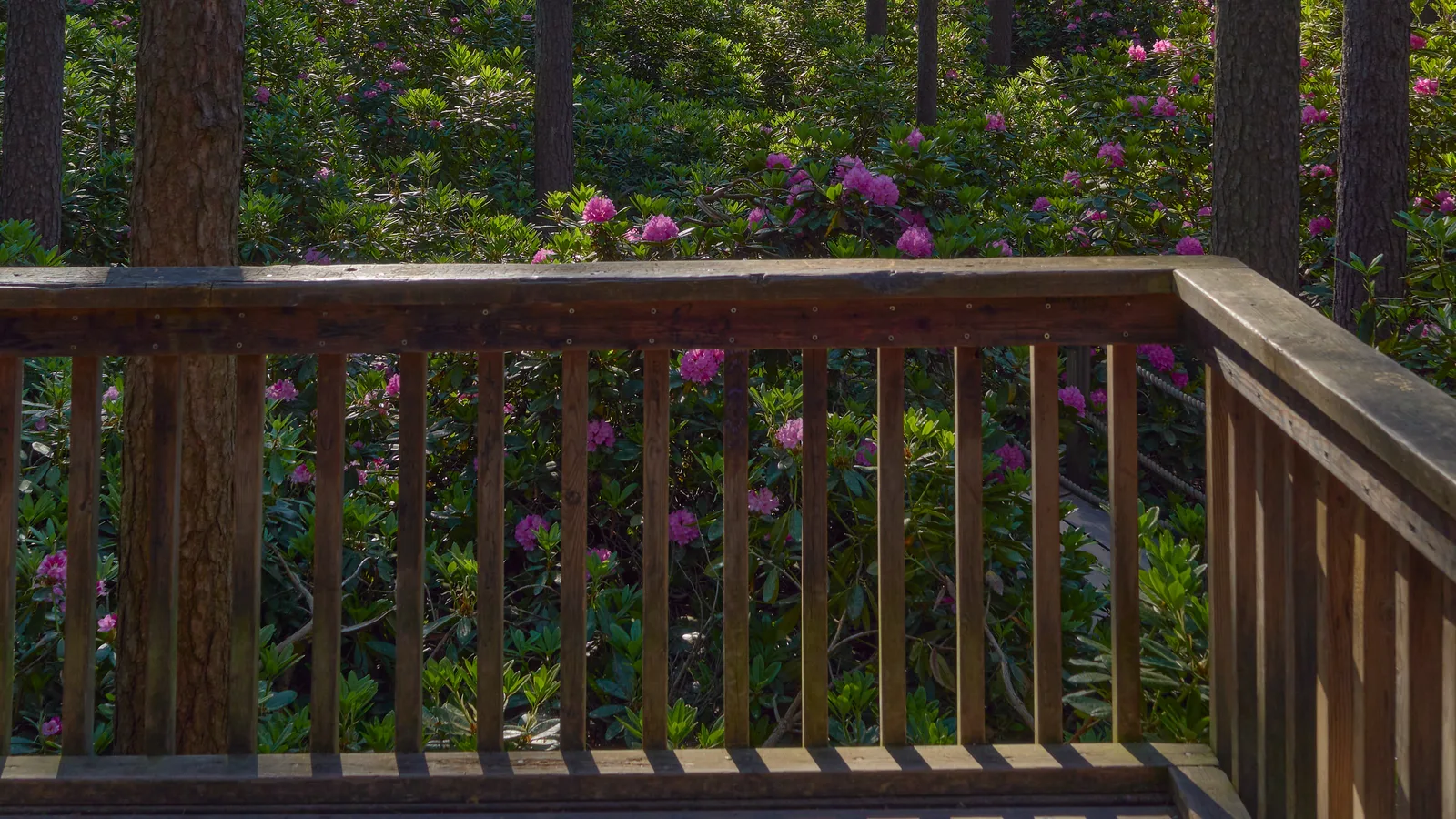
In the parts of Colorado mapped at moderate or high fire intensity, a new unenclosed deck now has to have a walking surface of noncombustible material, a Class A rated material, fire-retardant-treated wood rated for exterior use, or a tested ignition-resistant material. Composite boards are allowed if they carry at least a Class B rating. That is Section 404.5 of the 2025 Colorado Wildfire Resiliency Code, which the Colorado Division of Fire Prevention and Control says was established on July 1, 2025, through state rule 8 CCR 1507-39. Colorado is the newest state with deck rules like these, and the details differ from place to place.
Why codes single out the deck
Research summarized by NFPA's Firewise USA program, based on testing at the Insurance Institute for Business & Home Safety (IBHS), found that wind-blown embers mostly settle in the gaps between deck boards and where boards sit on the joists. Embers can also drop through those gaps onto whatever is stored below. A burning deck can then ignite siding or break door and window glass.
The same research found that medium-density softwoods such as redwood and western red cedar were vulnerable to ember ignition even with no debris in the gaps, while most wood-plastic composites, denser tropical hardwoods and fire-retardant-treated boards were less vulnerable. A second Firewise fact sheet adds that in IBHS tests, a mild 12 mph wind was enough to let a smoldering ember fire in a deck gap spread.
The national model codes
The International Code Council's International Wildland-Urban Interface Code (IWUIC) is a model code that a city, county or state adopts on top of its building and fire codes. ICC describes it as setting rules for land use and construction inside designated wildland-urban interface (WUI) areas, including ignition-resistant materials for roofs, siding, vents and decks. According to the Firewise deck fact sheet, the IWUIC rules out ordinary combustible deck boards except fire-retardant-treated decking rated for outdoor use and materials that meet its ignition-resistant test. It also allows enclosing the underside of the joists, which the fact sheet says suits only a solid deck surface, since water trapped under gapped boards causes rot.
NFPA's own standard is NFPA 1140, Standard for Wildland Fire Protection. NFPA says the 2022 edition combined several older standards, including NFPA 1144, Standard for Reducing Structure Ignition Hazards from Wildland Fire. Chapter 25 of NFPA 1140 holds its ignition-resistant construction rules for new buildings and substantial renovations.
California's approach
California has long handled combustible decking differently: rather than banning it, its code accepts deck boards that pass State Fire Marshal tests. The Los Angeles County Building and Safety Division's 2026 construction notes show the current menu for deck, porch, balcony and stair walking surfaces in a Fire Hazard Severity Zone: ignition-resistant material or material that meets both SFM Standard 12-7A-4 and the code's Section 503.2.4; exterior fire-retardant-treated wood; noncombustible material; material that meets SFM 12-7A-4A, provided the attached wall covering is also noncombustible or ignition-resistant; or material that passes both ASTM E2632 and ASTM E2726. The same notes say these provisions now sit in Part 7 of the state's building standards, the California Wildland-Urban Interface Code, rather than in the old Chapter 7A of the building code. Firewise notes that California's under-deck test measures the heat a board releases when a gas burner flames it from below, which mimics burning debris rather than embers. Products that have passed are published by the Office of the State Fire Marshal in its Building Materials Listing.
What Colorado's code covers, and what it does not
DFPC describes the Colorado code as a statewide minimum for new construction and significant exterior alterations and additions in the WUI, and says it is not a retrofit code. It works in two tiers. Parcels mapped at low fire intensity follow Class 1 rules; parcels mapped at moderate or high intensity follow Class 2, which adds the deck walking surface rule above. Both classes require the first 5 feet around a structure to be kept to hard, noncombustible surfaces such as rock, gravel, concrete or pavers (plants on an approved ignition-resistant list are the exception), with the stated aim of preventing ember ignition and direct flame contact with the house, decks, stairs and attachments.
Local governments enforce it, so start dates vary. Mesa County, for example, began enforcing the code on July 1, 2026, and lists decks among the projects in WUI areas that need a review or permit.
The ground under the deck
Whatever the code says about boards, Firewise guidance treats the space under a deck as part of the 0 to 5 foot immediate zone. Its fact sheets say nothing combustible should be stored beneath a deck, that debris should be cleared from board gaps and from the joint where the deck meets the house, and that the noncombustible zone around a home should take in the full footprint of an attached deck. For softwood decks, IBHS findings cited by Firewise point to 1/4-inch board gaps, 24-inch joist spacing and foil-faced bitumen tape on top of each joist to slow fire spread.
How to find out whether your address is covered
Every one of these codes applies only where a jurisdiction has adopted it and mapped the area. Under the IWUIC, a local legislative body declares the WUI areas. In Colorado, DFPC publishes a statewide map that shows the fire intensity class for each area, and local governments may adopt it or draw their own. Los Angeles County links a hazard zone lookup map from its construction notes. Before you design or replace a deck, call your local building department and ask three questions: whether your parcel is in a mapped WUI or fire hazard area, which code and edition the jurisdiction has adopted, and whether a deck permit triggers its wildfire rules.
This article reports rules, data and expert guidance. It is not legal, tax, insurance or financial advice. Talk to a licensed pro, your tax advisor or your insurer before you act on it.
Sources
- Colorado Division of Fire Prevention and Control: 2025 Colorado Wildfire Resiliency Code
- Colorado Division of Fire Prevention and Control: CWRC What and Why
- Colorado Division of Fire Prevention and Control: Wildfire Resiliency Code Board
- Mesa County, Colorado: Colorado Wildfire Resiliency Code
- Los Angeles County Building and Safety: Fire Hazard Severity Zone Standard Construction Notes (2026)
- International Code Council: Wildland-Urban Interface Code
- NFPA: Using Codes and Standards to Reduce Risk in Wildfire-Prone Areas
- NFPA Firewise USA: Reduce the Vulnerability of Your Deck to Wildfire
- NFPA Firewise USA: Fire Spread on Ember-Ignited Decks
- NFPA Firewise USA: Immediate (Noncombustible) Zone
Loading comments…