












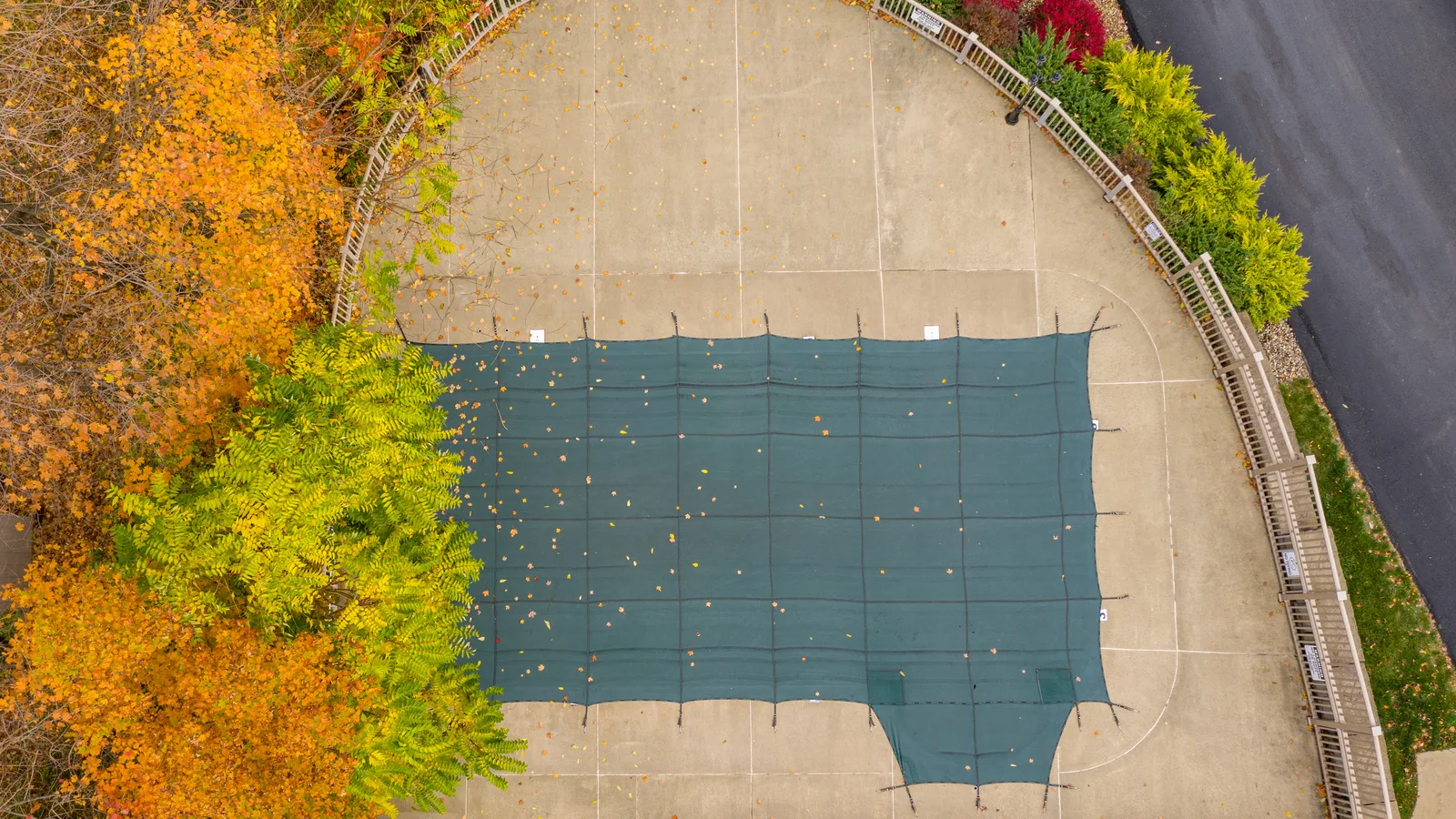
A solid winter pool cover keeps leaves and grit out of the water, but it is not built to keep a child out of it. The pool cover standard, ASTM F1346, separates safety covers, which are tested to hold a person above the water, from every other cover, which only has to carry a label. That gap matters most in the off-season, when a covered pool looks closed and a sheet of rain or snowmelt can sit on top of it for weeks.
Two products that look alike on a closed pool
ASTM International titles the specification for what it does: a performance specification for safety covers and labeling requirements for all covers for swimming pools, spas and hot tubs. The current edition is F1346-23, updated in July 2023. According to ASTM's summary, the standard is meant to lower the drowning risk for children younger than five by keeping them from reaching the water, as long as the cover is installed and used as the maker directs. It sets performance tests a safety cover has to pass, and it sets labeling rules that reach every cover sold, safety rated or not.
The Pool Safely campaign, run by the U.S. Consumer Product Safety Commission (CPSC), has described the practical bar in plain terms. Its archived guidance on safety covers said a cover should be able to bear the weight of two adults and a child, so a rescuer can reach someone who falls onto it, and that it should come off the water quickly in an emergency. The same guidance said that ladders and slides should be taken off a pool whenever a cover is used, so the cover keeps doing its job.
A typical solid winter cover held down with water bags or cables is not tested to that bar. Buyers who want to know which kind they own can check the label and the paperwork for an ASTM F1346 safety cover rating; a cover sold only for debris or winterizing will not claim one.
Why standing water on a cover is the hazard
CPSC has tracked this problem for decades. A 1986 CPSC staff briefing package on pool, spa and hot tub covers counted 29 incidents involving 31 victims reported between July 1973 and March 1985, with 23 deaths. Staff sorted them into two patterns: people trapped under a cover, and children who drowned on top of one. In 11 of the incidents, each a death, children appear to have walked onto a secured cover and fallen into water that had collected on its surface. All but one of those 11 victims (a nine-year-old) were younger than two. Thirteen of the 31 incidents involved solar covers; the rest involved canvas, vinyl or fiberglass covers, or covers of unknown type.
The current numbers
CPSC's most recent pool and spa submersion report, published in May 2026, counts drowning deaths of children younger than 15 that were reported to CPSC staff and associated with a pool or spa, whether or not the pool product itself caused the incident. It found an average of 376 such deaths a year from 2021 through 2023, with 379 in 2023, up from 359 in 2022. Children younger than five made up 77 percent of those deaths, and children ages one to three made up about 66 percent. Seventy-one percent happened at a residence: the child's own home, a relative's or friend's home, or a neighbor's. Deaths cluster in May through August, the report says, but they do not stop when the season ends.
Layers that still apply after Labor Day
CPSC's Safety Barrier Guidelines for Residential Pools (Publication 362) are not a mandatory standard, but they describe the barrier most local codes build on. The top of a pool fence should be at least 48 inches above grade, and some states and towns require 60 inches. The gap under the fence should be no more than 4 inches. Where the house forms one side of the barrier, CPSC lists door alarms meeting UL 2017 or a power safety cover that complies with ASTM F1346 as protections for that side.
For above-ground pools, the guidelines say the ladder or steps should be able to be secured, locked or removed, or should be surrounded by their own barrier. Pool Safely's off-season advice adds that above-ground and portable pools should be winterized according to the maker's directions, which can mean draining the pool, storing it and taking the ladder away, with the main goal of keeping rain and melting snow from collecting in an empty pool. For in-ground pools, it calls for a proper cover once summer ends and suggests a pool alarm so a child cannot get out a door and onto the cover unnoticed. CPSC's June 2026 drowning release repeats the core layers: self-closing, self-latching gates, door alarms, covers kept in working order and ladders secured or removed.
Owners who keep a solid winter cover can still cut the risk by clearing water off its surface after rain or a thaw, keeping the fence and gate latched all winter, and keeping the cover's controls and any removable ladder out of children's reach.
The question to ask before the next storm
Look at the label on the cover now on the pool. If it does not state that it meets ASTM F1346 as a safety cover, treat it as a debris cover, keep its surface free of standing water, and ask your pool service or local building department which barrier and alarm rules apply to your property this winter.
This article reports rules, data and expert guidance. It is not legal, tax, insurance or financial advice. Talk to a licensed pro, your tax advisor or your insurer before you act on it.
Sources
- U.S. Consumer Product Safety Commission: Pool or Spa Submersion, Estimated Nonfatal Drowning Injuries and Reported Drownings, 2026 Report
- U.S. Consumer Product Safety Commission: CPSC Report Highlights Persistent Risk of Childhood Drowning
- U.S. Consumer Product Safety Commission: Safety Barrier Guidelines for Residential Pools (Publication 362)
- U.S. Consumer Product Safety Commission: Briefing Package, Options on Covers for Swimming Pools, Spas and Hot Tubs (1986)
- Pool Safely (CPSC), archived: Safety Covers for Pools and Spas
- Pool Safely (CPSC): Five Simple Ways to Pool Safely 365
- ASTM International: F1346-23 Standard Performance Specification for Safety Covers and Labeling Requirements for All Covers for Swimming Pools, Spas and Hot Tubs
Loading comments…